Are you looking to enhance your singing voice in a short amount of time? Look no further, because in this article, you will discover some effective tips and techniques on how to improve your singing voice in just one week. Whether you’re a beginner or already have some experience, these simple yet powerful strategies will help you take your singing abilities to the next level. Get ready to unlock your full vocal potential and impress yourself and others with your newfound singing skills.
Warm up exercises
Before you begin your singing practice, it’s important to warm up your vocal cords and ensure they are ready for the task ahead. Here are a few warm up exercises that can help loosen up your vocal cords and prepare your voice for singing.
Lip trills
Start by relaxing your face and lips. Then, blow air through your lips in a relaxed and controlled manner to create a buzzing sound. This exercise helps to warm up the muscles of your lips and tongue, as well as improve your breath control.
Humming
Humming is a great exercise to warm up your voice and improve resonance. Start by taking a deep breath and then hum a comfortable pitch. Feel the vibrations in your face and head as you hum. This exercise helps to relax your voice and improve tone quality.
Tongue trills
Roll your tongue and place it against the roof of your mouth. Begin making a “rrrr” sound by exhaling and allowing the air to gently vibrate your tongue. This exercise helps to increase airflow and warm up the muscles of the tongue, leading to better articulation and control.
Sirens
Sirens are a fun and effective way to warm up your vocal range. Start from the bottom of your range and smoothly slide up to the highest note you can comfortably reach, and then back down again. This exercise helps to stretch and expand your vocal range, as well as improve pitch accuracy.
Breathing techniques
Proper breathing techniques are essential for singing with power, control, and endurance. Here are a few breathing exercises that can help improve your breath support and control.
Diaphragmatic breathing
Diaphragmatic breathing, also known as belly breathing, involves expanding your diaphragm rather than using shallow chest breaths. To practice diaphragmatic breathing, place one hand on your belly and take a deep breath, feeling your belly rise and expand. This exercise helps to improve your lung capacity and control over your breath.
Supportive breath
Supportive breath is the technique of using your diaphragm and abdominal muscles to create a steady stream of breath while singing. To practice supportive breath, take a deep breath and then exhale slowly and evenly, focusing on maintaining consistent airflow. This exercise helps to improve breath control and stamina.
Rib expansion exercises
Rib expansion exercises help to increase your lung capacity and improve breath control. Start by placing your hands on the sides of your ribcage. Inhale deeply and focus on expanding your ribcage laterally, feeling your hands move apart. Exhale fully and repeat the exercise several times. This exercise helps to increase the flexibility of your ribcage, leading to improved breath support.

Posture and body alignment
Proper posture and body alignment have a significant impact on your vocal performance. Here are a few exercises to improve your posture and relax tension in your body.
Standing posture
Stand up straight with your feet hip-width apart. Align your head, neck, and spine in a straight line and relax your shoulders. Distribute your weight evenly between both feet, and imagine a string pulling the crown of your head toward the ceiling. This exercise helps to align your body, allowing for better breath control and resonance.
Relaxing tension
Tension in your body can negatively impact your singing. Take a moment to relax each part of your body, starting from your toes and working your way up to your head. Pay special attention to your jaw, neck, and shoulders, as tension in these areas can affect your vocal production. This exercise helps to release any unnecessary tension, allowing for more freedom and flexibility in your voice.
Alignment exercises
Alignment exercises help to improve your body awareness and ensure proper posture while singing. Stand against a wall with your feet a few inches away from the wall. Gently press your lower back, shoulder blades, and the back of your head against the wall. This exercise helps to align your body and maintain good posture during your singing practice.
Vocal warm-ups
Once your body is warmed up and properly aligned, it’s time to focus on warming up your voice. Here are a few vocal warm-up exercises to improve your range, flexibility, and control.
Scales and arpeggios
Scales and arpeggios are fundamental exercises that help to improve your vocal range, agility, and pitch accuracy. Start by singing a simple major scale, ascending and descending through your range. Then, move on to arpeggios, which involve singing the individual notes of a chord in ascending and descending patterns. This exercise helps to train your ear and increase your vocal flexibility.
Vocal sirens
Vocal sirens are a great way to warm up your voice and improve your vocal range. Start by sliding smoothly from your lowest note to your highest note and back down again using a “ooo” or “ahh” sound. Focus on maintaining a smooth transition between the different vocal registers. This exercise helps to stretch and strengthen your vocal cords, improving your overall vocal range.
Lip trills
We already covered lip trills in our warm-up exercises section, but they are also beneficial for warming up your voice. Repeat the lip trills exercise while singing a series of scales, arpeggios, or simple melodies. This exercise helps to improve your breath control and coordination between your vocal cords and breath.
Descending slides
Descending slides are an excellent exercise for improving pitch accuracy and control over your voice. Start by singing a note, then gradually slide down to a lower note while maintaining the same pitch and control. This exercise helps to train your ear and improve your ability to hit precise pitches.
Pitch accuracy
Pitch accuracy is of utmost importance for any singer. Here are a few exercises to help train your ear and improve your pitch accuracy.
Ear training exercises
Ear training exercises involve listening to musical intervals or sequences and identifying their specific pitches. Use online resources or mobile apps specifically designed for ear training to practice identifying intervals and pitches. This exercise helps to improve your ability to hear and replicate different pitches accurately.
Interval practice
Interval practice involves singing or playing specific intervals, starting from a reference note. Start with simple intervals such as ascending and descending seconds, thirds, and fourths, and gradually progress to more challenging intervals. This exercise helps to improve your ability to sing in tune and accurately reproduce different melodic intervals.
Pitch matching exercises
Pitch matching exercises involve listening to a given pitch and then matching it with your voice. Use a singing app or a keyboard to play a note, and then try to replicate that pitch using your voice. Start with simple notes and gradually move to more complex melodies. This exercise helps to improve your ability to hit precise pitches and develop your ear for pitch accuracy.
Resonance and tone
Resonance and tone quality play a crucial role in creating a pleasant and powerful singing voice. Here are a few exercises to help improve resonance and tone.
Vowel shaping
Vowel shaping exercises involve practicing singing different vowel sounds to improve your resonance and tone quality. Start by singing simple scales or arpeggios while focusing on shaping your vowels. Pay attention to the openness and clarity of each vowel sound. This exercise helps to improve your ability to modify the shape of your vocal tract, resulting in better resonance and tone.
Nasal resonance exercises
Nasal resonance exercises help to balance the resonance between your nasal and oral cavities. Start by singing simple scales or melodies while focusing on directing the sound forward and away from the nasal cavity. Pay attention to the sensations and vibrations in your face and head. This exercise helps to improve your ability to control where your sound resonates, leading to a clearer and more balanced tone.
Forward placement exercises
Forward placement exercises involve singing with a focus on directing the sound forward and resonating in the front of your face. Start by singing simple scales or arpeggios while imagining the sound being produced just in front of your mouth and nose. This exercise helps to improve your ability to create a bright and forward tone.
Articulation and diction
Clear articulation and diction are essential for conveying the lyrics and meaning of a song. Here are a few exercises to help improve your articulation and diction.
Tongue twisters
Tongue twisters are fun and challenging exercises that help improve your articulation and diction. Practice saying tongue twisters such as “She sells seashells by the seashore” or “Peter Piper picked a peck of pickled peppers” in a clear and distinct manner. This exercise helps to improve your tongue and jaw flexibility, leading to better articulation while singing.
Diction exercises
Diction exercises involve practicing specific consonant sounds to improve clarity and precision in your singing. Start by singing simple scales or melodies while focusing on pronouncing the consonant sounds clearly and distinctively. Pay attention to any areas where you might be experiencing difficulty and continue to practice until you achieve clarity in your diction. This exercise helps to improve your ability to enunciate consonant sounds accurately.
Vocal consonant exercises
Vocal consonant exercises involve singing specific consonant sounds in a sustained manner to improve control and clarity. Start by singing a sustained “M,” focusing on maintaining a consistent pitch and tone throughout. Then, move on to other consonant sounds such as “N,” “L,” or “V.” This exercise helps to improve your ability to sustain and control the resonance while singing consonant sounds.
Range extension
Expanding your vocal range can be an exciting and challenging goal for any singer. Here are a few exercises to help extend your vocal range.
Vocal exercises targeting high notes
Vocal exercises targeting high notes involve practicing scales or arpeggios that specifically target the upper range of your voice. Start from a comfortable note and gradually ascend through your range, focusing on maintaining control and clarity in your voice. This exercise helps to strengthen and expand the muscles involved in producing higher notes.
Vocal exercises targeting low notes
Vocal exercises targeting low notes involve practicing scales or arpeggios that specifically target the lower range of your voice. Start from a comfortable note and gradually descend through your range, focusing on maintaining a rich and full tone in your voice. This exercise helps to strengthen and expand the muscles involved in producing lower notes.
Semi-occluded vocal tract exercises
Semi-occluded vocal tract exercises involve partially blocking the airflow while singing to improve vocal control and resonance. Start by singing scales or arpeggios while gently pressing your lips together or placing your tongue against the back of your top teeth. This exercise helps to promote vocal control and balance while expanding your range.

Vibrato development
Vibrato is a subtle variation of pitch that adds depth and expressiveness to your singing voice. Here are a few exercises to help develop your vibrato.
Breath control exercises
Breath control exercises involve sustaining long notes while maintaining a steady and controlled flow of breath. Start by taking a deep breath and then sustain a note on a comfortable pitch for as long as possible using steady breath support. This exercise helps to develop the necessary breath control for a controlled and expressive vibrato.
Vocal trill exercises
Vocal trill exercises involve quickly alternating between two adjacent pitches to develop flexibility and coordination in your vocal cords. Start by trilling between two notes that are comfortable for you, gradually increasing the speed and range of the trill as you progress. This exercise helps to develop the necessary muscle coordination for a smooth and natural vibrato.
Releasing tension
Tension in your body can inhibit the development of a natural vibrato. Take a moment to relax your body and release any tension before practicing vibrato exercises. Focus on letting go of any unnecessary muscular tension in your jaw, neck, and shoulders. This exercise helps to create a more relaxed and natural vibrato.
Practice routines
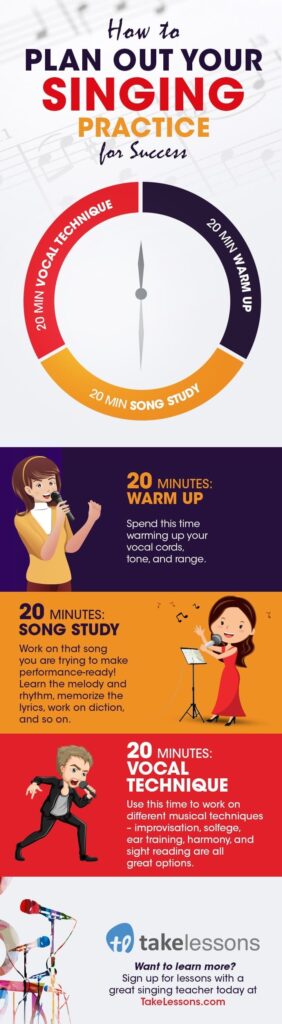
Developing a consistent and effective practice routine is key to improving your singing voice. Here are a few practice routines to help you structure your practice sessions.
Daily vocal warm-up routine
Start each practice session with a warm-up routine that combines exercises from each of the warm-up categories mentioned earlier. Begin with warm-up exercises like lip trills, hums, and sirens to loosen up your vocal cords. Proceed with breathing exercises to improve support and control, followed by posture and body alignment exercises to ensure proper technique. Finish with vocal warm-ups that target range, pitch accuracy, resonance, and articulation.
Focused technique practice
After completing your warm-up routine, dedicate a portion of your practice session to focused technique practice. Choose specific vocal exercises or sections of songs that target areas you want to improve, such as range, tone, articulation, or vibrato. Work on these exercises slowly and methodically, focusing on proper technique and repetition to build muscle memory and improve specific areas of your singing.
Song interpretation practice
To develop your overall performance skills, dedicate a portion of your practice session to song interpretation practice. Choose songs that challenge you vocally and emotionally, and work on expressing the meaning and emotions of the lyrics through your singing. Pay attention to dynamics, phrasing, and storytelling in your delivery. Experiment with different interpretations and find your unique voice within each song.
By incorporating these warm-up exercises, breathing techniques, posture and body alignment practices, vocal warm-ups, pitch accuracy exercises, resonance and tone exercises, articulation and diction exercises, range extension exercises, vibrato development exercises, and practice routines into your singing routine, you can make significant improvements to your singing voice in just a week. Remember to be patient, consistent, and gentle with yourself as you embark on this journey, and most importantly, have fun with it! Happy singing!


